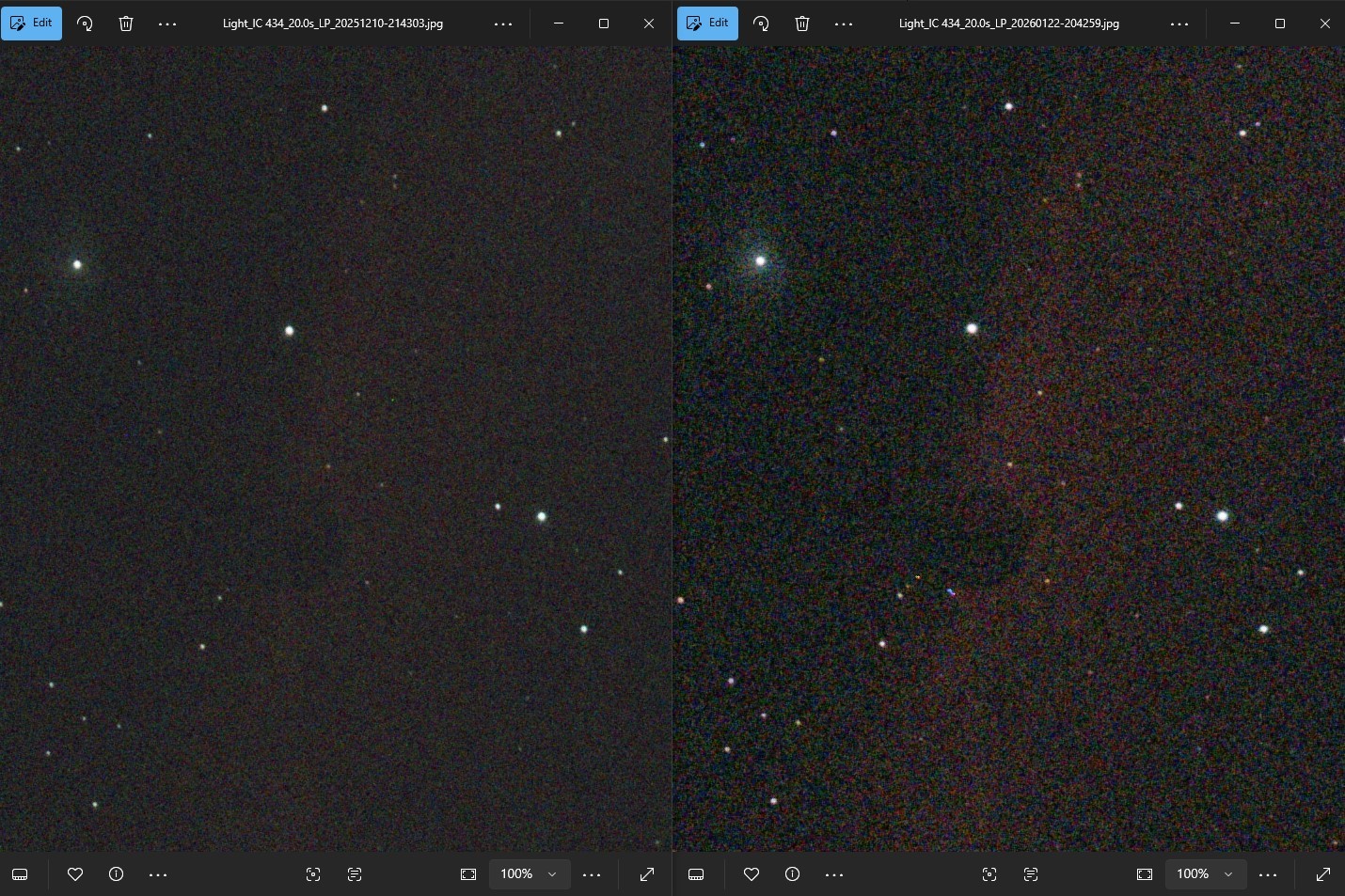
I think I’ve found a temporary workaround for myself - using 20s / 30s exposures.
Yes, under ideal conditions (no clouds and no wind, since I’m shooting from a balcony) I lose roughly 10+ % at 20s, but that’s still better than nothing.
One thing I want to point out is that I’m shooting under relatively poor urban skies (Bortle 6–7), and this works for me. If you have good dark skies (for example Bortle 3) I’m afraid you may still see these black pixels even at 20s. In your case, 30s+ exposures might work better.
I rule out temperature as the root cause, because I took 10s frames when the sensor temperature was +18 °C, and later when the sensor temperature dropped below +10 °C (with the outside temperature around −8 °C). The number of black pixels did not decrease.
From what I understand, the issue is likely somewhere in the part responsible for “image enhancement,” which seems to run either before each imaging session starts or when you switch to an exposure length that hasn’t been used since the telescope was powered on.
Below, I hope to add a visual example showing how my images look at 2s / 10s / 20s exposures.
https://bbs.zwoastro.com/assets/files/2026-01-22/1769111735-586600-s50.jpg

Taken on 3.0.2 app and v6.70 FW
cc: @support@Seestar